
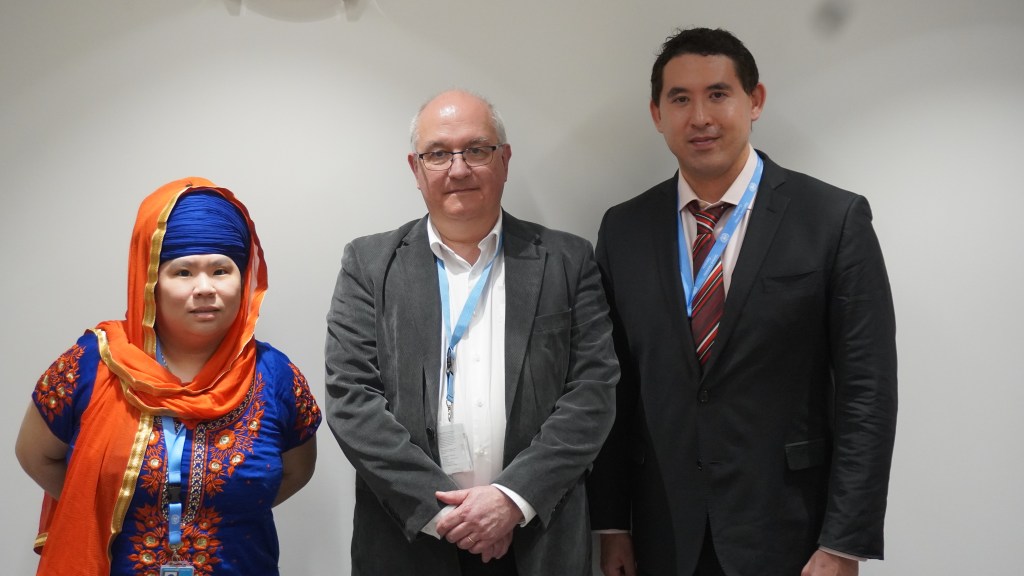
Palais des Nations, Geneva, Switzerland – In a significant step toward raising international awareness of their cultural and economic struggles, an Okinawan delegation under the leadership of the Peace For Okinawa Coalition convened with United Nations officials at the Palais des Nations in Geneva during the 58th session of the Human Rights Council. The delegation, representing the indigenous people of Okinawa, Ryukyu (pronounced Luchu in the native language), sought to address pressing issues surrounding their rights as a minority group under Japanese occupation, including Ryukyu’s struggling economy and military base issues. The meeting included discussions with Dr. Nicolas Levrat, the UN Independent Expert on Minority Issues, and Dr. Attiya Waris, the UN Independent Expert on Foreign Debt, Other International Financial Obligations, and Human Rights.
The representatives of the Peace For Okinawa Coalition included president Robert Kajiwara and U.S. area representative Simranbir Kaur. Additionally, Hoshin Nakamura and Sadako Yonamine also previously served as delegates in 2024. Kajiwara’s petition to stop the construction of the military base at Henoko, Okinawa received over 212,000 signatures. The Okinawan delegation expressed hope that their activities at the UN would mark the beginning of sustained international attention to their plight. They called for greater recognition of their rights under UN frameworks, including the Declaration on the Rights of Indigenous Peoples, and urged Japan to address historical grievances and economic inequalities.
“The Luchuan / Okinawan people’s voice must be heard,” Kajiwara stated during the meeting. “Our distinct identity and the issues we face deserve thorough examination and support from the global community.”
The Palais des Nations, a historic hub for international diplomacy and human rights advocacy, provided the backdrop for this critical dialogue. The Okinawan representatives highlighted their unique identity, language, religion, and traditions, which they argue have been marginalized by Japan. They expressed concerns over land use, militarization, and economic disparities that have disproportionately affected their communities, often exacerbated by broader national and international financial policies.
Dr. Nicolas Levrat, a Swiss lawyer and academic appointed to his role in 2023, listened attentively as the delegation outlined the challenges faced by Okinawans as a minority. Levrat is known for his work on protecting the rights of marginalized groups, emphasizing the importance of preserving cultural heritage, traditional religious practices, and ensuring equitable treatment under international human rights frameworks.
Meanwhile, Dr. Attiya Waris, a Kenyan fiscal law expert who has served as the UN Independent Expert on Foreign Debt since 2021, brought a financial perspective to the discussion. The Okinawan delegation raised concerns about how Japan’s economic policies have directly impacted Okinawa’s development. They pointed to the heavy presence of U.S. and Japanese military bases on the island, which they argue diverts resources and limits local economic autonomy. Waris’s mandate focuses on linking fiscal policy to human rights, and she is known for her work on exploring how global financial systems affect indigenous and minority populations.
According to Kajiwara, U.S. military bases take up around 15% of Okinawa’s land, and around 30% of Okinawa’s prime real estate, yet contributes only around 5% to Okinawa’s economy. Kajiwara noted that this does not include the many Japanese self-defense force bases that can also be found throughout the Ryukyu Islands. “The military bases in Luchu are a huge economic burden on the Luchuan people, and prevents Luchu’s economy from thriving like it did historically,” said Kajiwara. “Economic justice is inseparable from human rights. We must assess how these broader financial dynamics influence the lived realities of Okinawans.”
Kajiwara stated, “according to the Potsdam Declaration, Japan has no legal authority to govern the Luchu (Ryukyu) Islands. Therefore Luchu’s rightful independence must be immediately restored, and Luchu should once again resume its historic role as a neutral, demilitarized buffer zone in the Asia-Pacific region. This would benefit all countries, including America, China, Japan, and Southeast Asia, and would once again allow Luchu to become a center of international finance, trade, diplomacy, and cross-cultural exchange.”
The recent meetings in Geneva underscores the Palais des Nations’ role as a platform for marginalized groups to engage with global leaders. While no immediate resolutions were announced, the Peace For Okinawa Coalition stated that they believe that the international community will further investigate the issues raised and incorporate them into their respective reports to the UN Human Rights Council. The Okinawan delegation left Geneva with cautious optimism, viewing the dialogue as a vital step toward amplifying their cause on the world stage.


 Okinawa News Network
Leave a comment